

Designing Dynamic Protein Tubes with Cytoskeleton-Like Flexibility
Program-Specific Researcher (Suzuki Team of Furukawa Group)
Masahiro Noji
Masahiro Noji
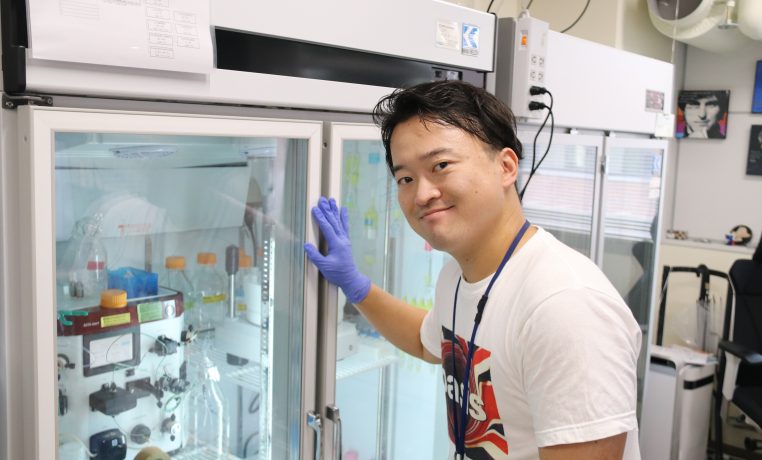
Masahiro Noji has been exploring the formation of artificial protein assemblies. In his recent work, he focused on combining two distinct designed proteins to create tube-like structures with dynamic, cytoskeleton-like flexibility. Through this research, he succeeded in generating protein tubes that not only demonstrate structural order but also exhibit dynamic properties, opening new possibilities in the field of protein design.
Please share with us the significance of your manuscript in terms of its research achievements, impact, or uniqueness.

Proteins are typically formed when chains of amino acids, like beads on a string, spontaneously fold into three-dimensional structures. These structures support life by providing diverse biological functions. Protein design seeks to artificially modify existing amino acid sequences or create entirely new ones, giving rise to proteins with desired properties.
As highlighted by the 2024 Nobel Prize in Chemistry, computational methods for protein design have advanced rapidly, enabling the prediction and creation of static protein structures. However, designing dynamic, flexible assemblies—like those found in living systems—remains a major challenge.
In this work, I designed two artificial proteins and combined them to successfully create tube-like assemblies that show dynamic and flexible properties reminiscent of cytoskeletal filaments. To my knowledge, this is the first time such a dynamic two-component protein tube has been achieved.
This accomplishment demonstrates the power of “intuitive protein design,” where the inherent properties of proteins are maximized, rather than relying solely on computational approaches. At the same time, I believe our study complements computational methods and shows how both approaches together can lead to highly functional protein assemblies.
Please tell us what was the most gratifying or inspiring moment for you during this research project.
The most inspiring moment came when I first saw the tube structure under the electron microscope. Until then, only spherical assemblies had formed, and there were many mentally exhausting periods. But after making a small adjustment to the protein design, I suddenly observed clear tube structures. The sense of joy and relief was overwhelming.
I vividly remember thinking that if it were allowed, I would keep the result a secret and savor that personal joy forever (and I still think that). However, my wild ambition was instantly crushed. Right afterward, research student N from the Suzuki team walked into the electron microscopy room, and I had to share the exciting news on the spot.
Please tell us about the biggest challenge or problem you experienced while conducting your research. How did you overcome it?
The biggest challenge was reaching the first successful tube formation. The initial design did not work, and even small modifications failed to produce results. Eventually, I overcame it by further adjusting the design. Later I realized that I had been fortunate to hit on near-optimal solution conditions from the very beginning, and in that sense, luck also played a big role.
With the support of Associate Professor Yukihiko Sugita at Kyoto University’s Institute for Life and Medical Sciences (iLMS), a co-author of the paper, I also analyzed the tube structures using cryo-electron microscopy (Cryo-EM). Because of the sample characteristics, the extraction of tubes from cryo-EM images could not be automated, so I remotely operated a workstation at iLMS and manually extracted them. The work itself was simple, but the number of images and tubes was enormous, and I had to repeat the process for three different samples.
I managed to get through this with the help of dividing tasks with Assistant Professor Suzuki, listening to bands like Oasis and U2, and using a trackball mouse, which saved me from developing the tendonitis I surely would have gotten with an ordinary mouse.
Would you consider this work to be a turning point in your overall research direction? If so, how has your research direction changed as a result of this work?
During my student days, I studied amyloid fibril formation in proteins. It was only after becoming a postdoctoral researcher under Assistant Professor Suzuki that I entered the world of protein design. This project was therefore my very first work in protein design, and in that sense, it was definitely a turning point that deepened my interest in the field.
Through this project, I not only learned the intuitive design methods that Assistant Professor Suzuki specializes in, but also began to explore computational approaches out of personal interest. I find both approaches fascinating and hope to integrate them into my future research.
This may go slightly beyond the question, but I would also add that the many encounters and connections I gained through this project have been an invaluable source of inspiration.
Please describe the current situation of your career. What is your current position? How has the knowledge and experience gained at iCeMS influencing your career?
I am currently working in the same position as when the paper was published, as a Program-Specific Research Associate in the Suzuki Team of the Furukawa Group at iCeMS.
When the paper came out, a press release was issued quickly, which showed me how strong the support system at iCeMS is. The Suzuki Team is mainly just Assistant Professor Suzuki and myself, so we sometimes struggle with limited manpower, but the facilities and collaborative framework are excellent.
Even though computational methods are not part of Assistant Professor Suzuki’s usual style, I have been able to study and practice them whenever possible thanks to the open and flexible research environment. I am also very grateful to our administrative staff, whose support has been essential in sustaining our research activities.
Overall, I feel fortunate to be here. The supportive and collaborative atmosphere not only enabled me to take on ambitious projects in protein design but has also had a lasting influence on my career development.
Paper information
“Protein design of two-component tubular assemblies similar to cytoskeletons”
Authors: Masahiro Noji, Yukihiko Sugita, Yosuke Yamazaki, Makito Miyazaki, and Yuta Suzuki
Published: July 2025